
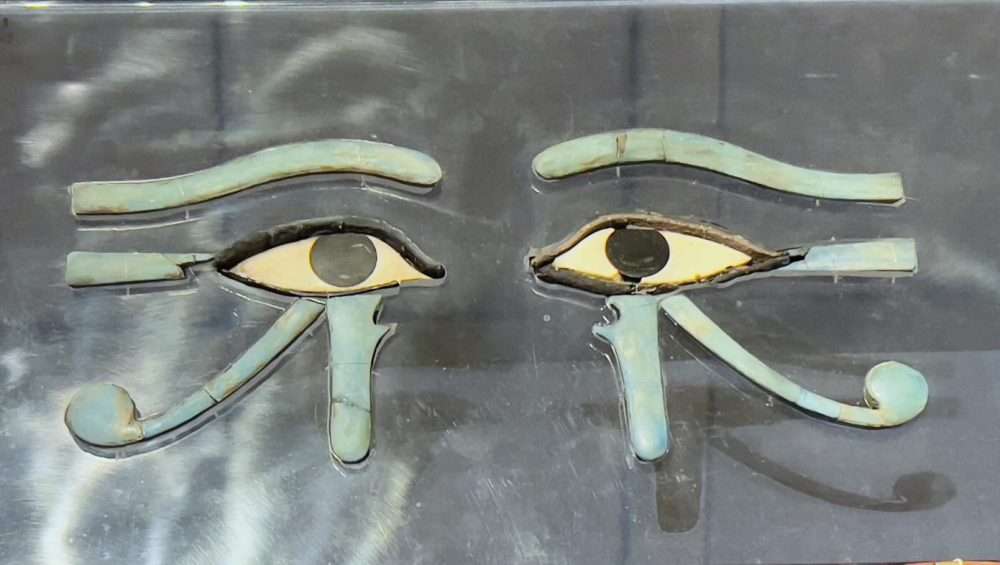
If you’ve ever found yourself spiraling down an ancient Egypt rabbit hole—maybe after spotting a mysterious eye symbol on jewelry or a tattoo—you’ve likely come across two names: the Eye of Ra and the Eye of Horus. At a glance, they look similar. Both are ancient Egyptian symbols shaped like stylized eyes, both seem to carry a certain mystical weight, and both show up in art, amulets, and popular culture. But are they the same thing?
Not exactly. Though related in some ways, they actually represent different deities, concepts, and even energies. And the difference isn’t just academic—it gives you a deeper window into how the ancient Egyptians saw the world.
Let’s untangle this a bit.
First, the Basics

The Eye of Horus, also known as the Wedjat, is probably the more familiar of the two. It’s the one with the distinctive teardrop and the swooping spiral beneath the eye—often associated with healing and protection. Horus, the falcon-headed god, was a sky deity. His right eye represented the sun, and his left, the moon. There’s a myth where he loses one of his eyes in a battle with Set, the god of chaos. The eye is later magically restored—sometimes by Thoth, depending on the version—and becomes a symbol of recovery, wholeness, and safety.

Then there’s the Eye of Ra, which is a little harder to pin down. Ra is the sun god, one of the oldest and most powerful figures in Egyptian mythology. But the “Eye of Ra” doesn’t refer to his literal eye. It’s more like a fiery, protective force—a feminine extension of Ra’s power. It’s associated with goddesses like Sekhmet, Bastet, Hathor, and Mut, who could be both nurturing and destructive, depending on Ra’s mood and what the situation called for.
So, the Eye of Horus is about healing. The Eye of Ra is about power. Simple?
Well, not quite.
Overlapping Symbols, Different Functions
One of the confusing things is that visually, the two eyes are often shown in the same way, or at least similarly. In some artistic renderings, they’re even identical, except maybe one is facing right and the other left. That blurs things.
But the meaning behind each is where the real difference lies.
The Eye of Horus is mathematical, in a way. Ancient Egyptians even used parts of it to represent fractions. That says a lot about how they saw it—not just spiritual, but also logical, orderly, a symbol of harmony and restoration.
The Eye of Ra, on the other hand, is mythological chaos. It’s unpredictable. It’s what Ra sends out when he’s angry or threatened. In some stories, he dispatches the Eye as a goddess—Sekhmet is a frequent pick—to punish humanity for disobedience. There’s even a version where she goes a little too far and starts wiping people out indiscriminately, until Ra tricks her into drinking beer dyed red to look like blood. She passes out, wakes up as Hathor, and suddenly she’s the goddess of love and joy. That’s the kind of duality the Eye of Ra embodies—fierce one minute, benevolent the next.
That said, both eyes are protective, just in different ways. Horus protects through healing and balance. Ra protects through overwhelming force.
Gender and Divine Energy
Another interesting distinction? Gender.
The Eye of Horus is usually masculine—it is Horus’s eye, after all. The Eye of Ra is almost always feminine, personified through goddesses. This gendered divide isn’t arbitrary; it reflects how the Egyptians thought about divine power. Male deities were often associated with order, logic, structure. Female deities had more to do with emotion, magic, transformation. Neither was better than the other. Just different.
And maybe that’s what makes the two eyes so compelling: they represent two sides of the same cosmic coin.
So… Which One Should You Wear?
Let’s be honest—part of the reason we even ask about this stuff today is because these symbols are everywhere. Jewelry, tattoos, décor. You might be wondering which one to wear for protection or symbolism.
There’s no “wrong” choice, of course, but they carry slightly different vibes.
If you’re drawn to the idea of healing, inner clarity, and restoration—especially after hardship—the Eye of Horus might resonate more. It’s a symbol of putting things back together, of surviving and thriving. It’s calm, wise energy.
But if you’re looking for strength, fire, or something to ward off destructive forces (external or internal), the Eye of Ra brings a more aggressive, commanding presence. It’s about asserting power, setting boundaries, sometimes burning bridges when necessary.
Personally, I’ve always found the Eye of Ra a little intimidating. Powerful, yes—but there’s something unpredictable in it, like it might turn on you if you misuse it. The Eye of Horus feels gentler. More forgiving. That might just be a modern reading, but even so, it’s hard to ignore how different their stories are.
Final Thought
Maybe the biggest takeaway is that ancient symbols rarely have just one meaning. The Egyptians weren’t trying to create a neat diagram of divine traits. They were telling stories, living with paradox, and personifying forces they didn’t fully understand. Sound familiar?
So when we ask, “What’s the real difference between the Eye of Ra and the Eye of Horus?”—the answer depends. On the myth. On the moment. On what you’re looking for.
And maybe that’s why, thousands of years later, we’re still talking about them.