When we imagine Ancient Egypt, it’s often in terms of its stillness—monuments baked in sun, hushed tombs painted with careful strokes, desert wind passing through empty temples. But that image is only half the story. These were also people who knew how to celebrate. Who threw festivals loud enough to fill city streets and riverbanks. Who danced, drank, feasted—and prayed—with equal intensity.
Not all of it was grand. Some of it was quiet, almost private. A yearly ritual in a household, or a small neighborhood honoring a local deity with offerings of bread and beer. But then there were the bigger ones—the national festivals that could shake Thebes or Memphis awake with color, music, incense.
One of the most famous of these was the Opet Festival, dedicated to the god Amun. It took place in Thebes, during the flooding season of the Nile. The flooding, oddly enough, was good news. It meant fertility, renewal, crops in the months ahead. So the timing wasn’t random. During the festival, the statue of Amun was taken from Karnak Temple to Luxor Temple in a ceremonial procession—sometimes by boat along the Nile, sometimes by land. Either way, people would line the route, cheering, singing, watching their god pass by.
The pharaoh played a central role. He wasn’t just a spectator. Part of the ritual involved renewing his divine right to rule. So, in a way, the festival wasn’t just religious—it was political too. A reminder that order (ma’at) still reigned in Egypt, that chaos was still kept at bay.
That overlap between religion and politics… it never really separated in ancient Egypt. Gods and rulers existed in the same space. The divine and the earthly blurred. Their festivals reflected that blend.
But not all festivals were about kings and national gods.
Wepet-Renpet, the New Year festival, marked the start of the Egyptian calendar year—also aligned with the Nile flood and the heliacal rising of Sirius. That rising, by the way, was a big deal. It meant the river was coming back to life. People welcomed it with celebration and, perhaps more interestingly, with caution. The flood could bring abundance, or it could bring destruction. There was always that edge. That mix of joy and fear. Humans hoping the gods were still in a generous mood.
Then there was the Feast of the Valley, which has a different flavor entirely. It was a kind of Day of the Dead, Egyptian-style. People crossed the Nile to visit the tombs of their ancestors on the west bank, bringing food, drink, and music. They would camp near the tombs overnight, share meals, light lamps, speak the names of the dead aloud. Not solemn, necessarily. Not weeping. More like remembering. Honoring. A reunion of sorts—though of course one-sided.
I find that particularly moving. The idea of including your deceased loved ones in the celebration, not separating life and death so strictly. That’s not something you see in every culture.

There were also festivals that were… stranger. Or at least more difficult to picture clearly. Like the Beautiful Festival of the Desert, tied to the goddess Hathor. Some scholars suggest it had elements of fertility rites, ecstatic music, heavy drinking. Hathor, after all, was the goddess of love, beauty, music, and intoxication. Worshiping her might’ve involved letting go, losing yourself in rhythm and revelry. Almost the opposite of the more controlled, choreographed state rituals.
And there were traveling festivals. Temporary shrines carried through towns and villages, spreading the presence of a god to those who couldn’t visit a major temple. Like a divine roadshow. Which, depending on how you look at it, feels either oddly commercial or deeply generous. Maybe both.
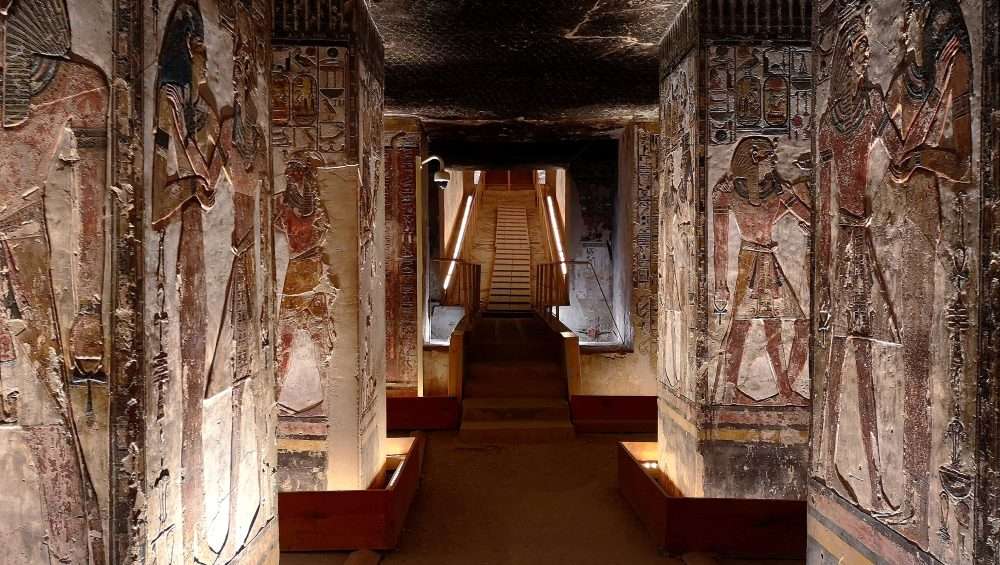
The truth is, we don’t know everything. Some festivals are mentioned only in fragments—on temple walls, papyri, or tomb inscriptions. We can read that “there was dancing” or “gifts were offered,” but we don’t always know what that looked like in practice. Were there plays? Costumes? Did people tell stories around fires late into the night? Did kids get excited the way they do now, hearing the drums from far away?
It’s tempting to fill in the gaps with our own assumptions. To imagine them like our holidays today—some version of a New Year’s Eve party, a street parade, a family gathering. And maybe there were moments that felt like that. Familiar in rhythm, even if the gods were different.
But Ancient Egypt had its own logic, its own emotional language. Joy, in that world, was bound up with cosmic balance. Celebrating wasn’t just for fun—it helped maintain the harmony of the universe. That sounds lofty, but for them, it was practical. If you honored the gods, the river would rise. The crops would grow. The stars would stay on course.
Still, you have to believe that some people—maybe a tired farmer or a priest’s young daughter—didn’t think too hard about cosmic order. Maybe they just liked the music. Or the beer. Or the candles lit along the river at night, flickering like stars in water.
Not everything has to be profound.
And that’s maybe the most human thing about these festivals. They were sacred, yes—but they were also full of life. Messy, noisy, imperfect. Some people probably took it too seriously. Others probably didn’t take it seriously enough. There were the devout, the curious, the bored, the skeptical. Like any crowd, really.
But for a few days each year, everyone paused. Gathered. Remembered the gods. Remembered each other. And for a moment, the city, the fields, even the desert itself pulsed with something bigger—something joyful.
Even now, thousands of years later, the traces of those days still linger in stone. You can almost hear the echo, if you listen closely.