
Ancient Egyptian Cities: A Gateway to a Lost Civilization
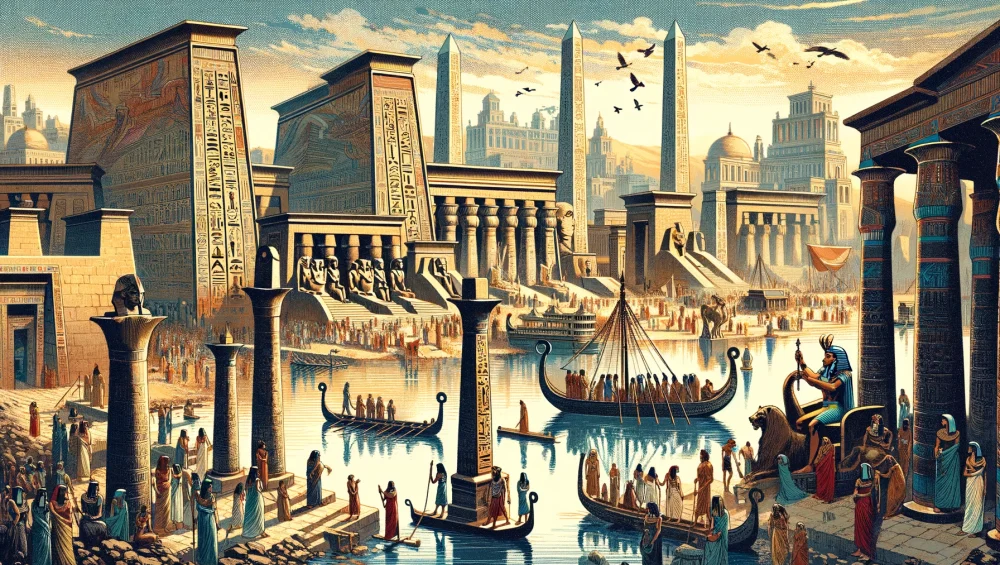
The ancient Egyptian civilization, flourishing along the fertile banks of the Nile River, is one of the most iconic and enduring legacies of human history. At the heart of this remarkable society were its cities, hubs of culture, trade, and innovation. Each ancient Egyptian city tells a unique story, shedding light on the daily lives, spiritual beliefs, and technological advancements of this bygone era. In this article, we explore the most significant ancient Egyptian cities and their contributions to history.
Memphis: The First Capital of Ancient Egyptian Cities
Memphis, known as “Ineb-Hedj” in ancient times, served as Egypt’s first capital after the unification of Upper and Lower Egypt around 3100 BCE. Located near the apex of the Nile Delta, Memphis was a bustling metropolis, strategically positioned to control trade and communication.
The city was home to the sprawling temple complex of Ptah, the god of craftsmen and architects. Moreover, today, the remnants of Memphis include colossal statues and artifacts that highlight its historical and cultural significance. Consequently, its legacy as a political and religious center makes Memphis an essential chapter in ancient Egyptian history.
Thebes: Religious and Cultural Hub of Ancient Egypt
Thebes, or “Waset,” was the spiritual and political heart of the New Kingdom (c. 1550–1070 BCE). Situated on the Nile’s east bank, Thebes became synonymous with grandeur and religious devotion. For instance, it housed the temples of Karnak and Luxor, two of the most impressive architectural feats of ancient Egypt.
Karnak, dedicated to the god Amun-Ra, was an ever-expanding temple complex that reflected the wealth and power of pharaohs like Hatshepsut, Seti I, and Ramses II. Additionally, Luxor Temple, connected to Karnak by the Avenue of Sphinxes, served as a focal point for the annual Opet Festival. As a result, Thebes’ influence extended far beyond its time, cementing its place as a symbol of divine power and human ingenuity.
Alexandria: The Intellectual Center of the Ancient World
Founded by Alexander the Great in 331 BCE, Alexandria became a hub of Hellenistic culture and learning. Unlike other ancient Egyptian cities, Alexandria embodied a fusion of Greek and Egyptian traditions. Its most famous landmarks included the Great Library, one of the largest repositories of knowledge in antiquity, and the Lighthouse of Pharos, a wonder of the ancient world.
Alexandria’s strategic location on the Mediterranean coast made it a center for trade and diplomacy. Furthermore, though much of the ancient city lies beneath modern Alexandria, its legacy as a cultural and intellectual powerhouse endures.
Abydos: The Religious Capital of Ancient Egypt
Abydos, located in Upper Egypt, was one of the oldest and most revered cities in ancient Egypt. Known as the burial place of Osiris, the god of the afterlife, Abydos attracted pilgrims from across the land. For example, the Temple of Seti I, with its beautifully preserved reliefs, and the Osireion, a symbolic tomb of Osiris, highlight Abydos’ religious significance.
Abydos was not just a religious center but also an early political hub. Excavations have uncovered tombs of Egypt’s earliest kings, revealing insights into the formation of the pharaonic state. Therefore, Abydos played a pivotal role in shaping early Egyptian civilization.
Amarna: Akhenaten’s Visionary City
Amarna, or “Akhetaten,” was a short-lived capital established by Pharaoh Akhenaten during his religious revolution in the 14th century BCE. Dedicated to the worship of Aten, the sun disk, Amarna broke with traditional Egyptian polytheism.
The city’s unique art and architecture reflect Akhenaten’s radical ideas. Additionally, the Amarna Letters, a collection of diplomatic correspondence, provide valuable insights into the political and social dynamics of the period. Though abandoned shortly after Akhenaten’s death, Amarna remains a fascinating chapter in Egyptian history.
Saqqara: Necropolis of Ancient Egyptian Kings
While not a city in the traditional sense, Saqqara was a vast necropolis associated with Memphis. It is home to the Step Pyramid of Djoser, the world’s oldest monumental stone structure, designed by the architect Imhotep.
Saqqara served as a burial ground for centuries, showcasing the evolution of Egyptian funerary practices. For instance, tombs adorned with vibrant wall paintings and inscriptions offer a glimpse into the beliefs and aspirations of ancient Egyptians regarding the afterlife. Consequently, Saqqara stands as a testament to the ingenuity and artistry of this ancient civilization.
The Legacy of Ancient Egyptian Cities and Their Innovations
Ancient Egyptian cities were more than just centers of administration and trade; they were living embodiments of a civilization that valued innovation, spirituality, and artistry. Each city contributed uniquely to the cultural mosaic of ancient Egypt, leaving behind a legacy that continues to inspire awe.
Exploring these ancient cities provides a window into the lives of one of history’s most fascinating civilizations. Therefore, from the political might of Memphis to the intellectual brilliance of Alexandria, the cities of ancient Egypt remain timeless treasures of human achievement.
Tours to Ancient Egyptian cities
Every piece of land in ancient Egypt has a story to tell so don’t miss the chance to listen to the stories of a lifetime. Through our Egypt vacation packages & Nile river cruises, you will explore the ancient cities of ancient Egypt and discover the true meaning of greatness and beauty.