For nearly a century, the name Tutankhamun has stirred a mix of awe, curiosity, and something close to reverence. His tomb, unearthed in 1922, captivated the world with its golden mask and the strange, silent weight of ancient mystery. Now, in 2025, the Grand Egyptian Museum—finally open after years of anticipation—has unveiled a new exhibition dedicated entirely to the boy king. And it’s… something else.
Not just bigger. Deeper.
This isn’t your standard walk-through of old artifacts with plaques and polite lighting. The new King Tutankhamun exhibition feels like a reintroduction. Like Egypt is reasserting ownership over its most famous pharaoh, not just as a relic of the past, but as a symbol—complex, young, possibly misunderstood.
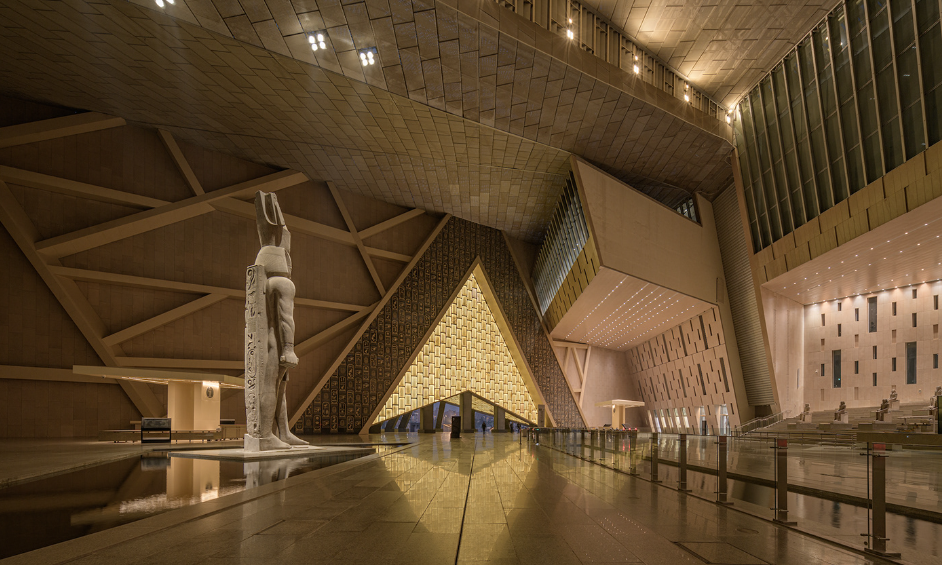
The museum itself, located just outside Cairo near the Giza Plateau, already carries an almost mythic weight. Decades in the making, beset by delays, cost overruns, and political shifts, it’s been a project many thought might never fully come together. But here it is. The architecture alone is striking: minimalist, angular, enormous. There’s a view of the pyramids from the entrance hall that honestly feels staged, like something from a movie. And maybe that’s part of the point.
But it’s Tutankhamun who steals the show.

More than 5,000 objects—many never before seen by the public—are on display. Some were tucked away in storage for decades. Others have been painstakingly restored, including delicate sandals, ceremonial weapons, and a linen tunic that, under glass, seems impossibly modern. The famous gold mask, of course, is there too. You’d think it might lose its impact after so many reproductions, but no. It doesn’t.
Curators have chosen to focus less on the mythology and more on the context of his life and reign. He wasn’t, after all, a particularly powerful or long-ruling pharaoh. He came to the throne at nine. Died around nineteen. His brief reign was marked more by a return to old religious traditions than by any great conquests or architectural triumphs. And yet—somehow—he’s the face of ancient Egypt to most of the world.
There’s a subtle critique running beneath the exhibition. A quiet pushback against how Tutankhamun has been presented, especially in the West. For years, his treasures toured foreign museums, drawing millions. They were treated almost like props—famous because they were famous. Here, though, the tone shifts. This is about re-grounding him in Egypt. In history.
One room recreates the layout of the tomb as Howard Carter found it. Dim lighting. Objects clustered chaotically. A kind of organized disorder. It’s oddly moving. You realize how much of what we know about Tutankhamun is shaped by that single moment of discovery, frozen in time, like a photograph. But history is rarely that neat.
There’s also a more interactive angle. Visitors can use augmented reality to “see” how objects might have looked originally—colors restored, wear reversed. It’s a bit gimmicky, maybe, but also genuinely useful. A faded wooden chariot suddenly gleams in gold. The illusion is temporary, sure, but it opens a window to something that’s hard to imagine otherwise.
Walking through the exhibit, you start to notice how much of it is about youth. Not just the fact that Tutankhamun was a teenager when he died, but something more layered. The objects suggest a life still being formed—child-sized chairs, games, delicate cosmetics. You can almost feel the presence of a person who never really got to be one.
And then there’s the question that always lingers: how did he die?
Theories abound. Infection. Genetic disorders. Malaria. A chariot accident. The exhibition doesn’t settle the debate, and maybe that’s the right choice. Mystery, after all, is part of what keeps people coming back. Still, there’s something unsettling in how much is left unknown. How much will always be unknown.
Of course, the politics around such an exhibition can’t be ignored. Egypt’s government is clearly using the Grand Egyptian Museum—and the Tutankhamun exhibition in particular—as a centerpiece of cultural diplomacy and tourism revival. Fair enough. There’s a sense of pride here, and not unearned. After decades of having Egyptian treasures scattered across European and American institutions, there’s a quiet message: we’re telling our story now.
But it’s not overly nationalistic or heavy-handed. In fact, the tone is surprisingly thoughtful. It seems to acknowledge the strange global fame Tutankhamun has acquired—while gently tugging the narrative back home.
Visitors are already pouring in. Not just tourists, but Egyptians too—school groups, families, elderly couples who remember the old Cairo museum and its creaky floors. One middle-aged man stood silently before the golden mask for what must have been ten minutes. No phone. No selfies. Just… standing.
Maybe that’s the most striking thing. For all the tech, all the design, all the careful curation, the heart of the exhibition is still emotional. Human.
Because King Tut, for all the layers of meaning that have been heaped upon him, was just a boy.
And somehow, 3,000 years later, that still matters.