Ancient Egyptian Coffins: A Journey Through History, Symbolism, and Beliefs
Ancient Egyptian civilization is one of the most fascinating in human history, renowned for its art, architecture, religion, and elaborate burial practices. Among the most intriguing aspects of their funerary traditions are Los antiguos ataúdes Egipcios, which were not merely containers for the deceased but held deep symbolic meaning, reflecting religious beliefs, social status, and the hope for eternal life. These coffins provide a unique window into the values, craftsmanship, and spiritual outlook of the Egyptians, making them a subject of great historical and archaeological importance.
Origins and Early Development of Ancient Egyptian Coffins
The earliest coffins in ancient Egypt date back to the Old Kingdom (around 2686–2181 BCE). At that time, coffins were simple rectangular wooden boxes with little decoration. Their primary purpose was to protect the body from decay and scavenging animals. However, even in these early stages, coffins were designed to symbolize the connection between the physical body and the afterlife.
By the Middle Kingdom (2055–1650 BCE), Los antiguos ataúdes Egipcios had become more elaborate, with painted decorations, inscriptions, and religious texts. These designs were intended to guide and protect the deceased in the afterlife. The famous “Coffin Texts,” for example, were inscribed directly onto the interior of coffins, serving as magical spells and instructions to help the soul (ka) navigate the challenges of the underworld.
Symbolism and Religious Beliefs
To the Egyptians, death was not the end of existence but a transition to another realm. The coffin played a central role in this journey. Symbolism was everywhere:
-
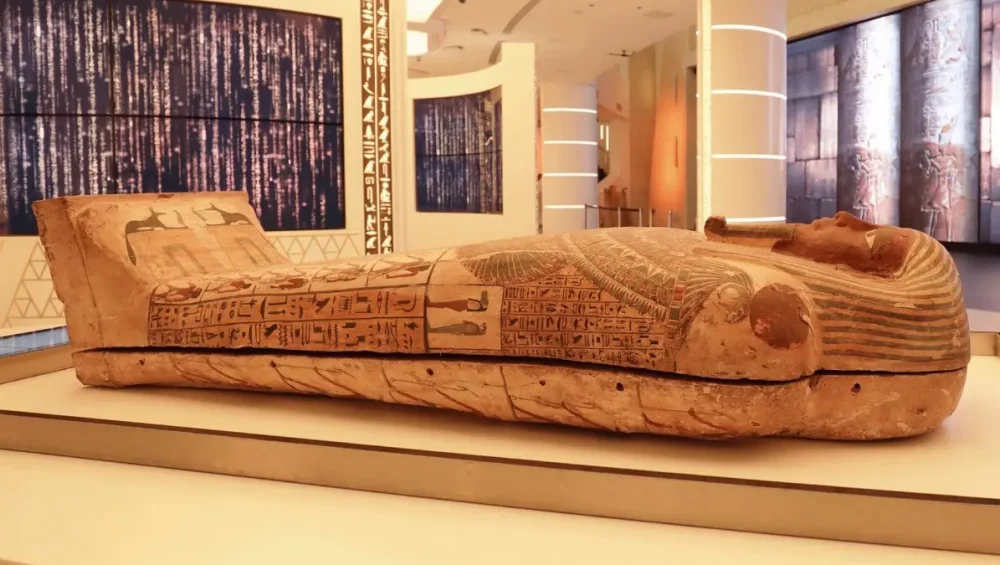
Shape and Decoration: Coffins were shaped to resemble the human form, especially from the Middle Kingdom onward. This anthropoid design emphasized the individual’s identity and offered a spiritual substitute for the body should it be damaged.
-
Colors: Colors carried sacred meaning. Yellow often symbolized the eternal and indestructible qualities of gold, while green represented rebirth and renewal, linked to Osiris, the god of the afterlife.
-
Protective Deities: Coffins frequently bore images of gods such as Anubis, Isis, and Osiris, who guarded the deceased on their journey.
-
Inscripciones Jeroglíficas: Texts on coffins served as protective spells. They included prayers, invocations, and magical formulas to ensure a safe passage through the afterlife.
In short, the coffin was more than a resting place; it was a magical tool to guarantee immortality.
Materials and Craftsmanship
The choice of materials used for Los antiguos ataúdes Egipcios reflected both status and availability. The wealthiest Egyptians, such as pharaohs and nobles, could afford finely carved wooden coffins made from imported cedar from Lebanon, prized for its durability and quality. Others relied on native Egyptian woods such as sycamore.
Coffins were often painted in bright colors, covered with plaster (gesso) to provide a smooth surface, and in some cases, even gilded with gold. For royalty, stone sarcophagi were also used, placed inside tombs as additional protection. These massive stone containers often bore carved hieroglyphs, scenes of rituals, and divine symbols.
Artisans demonstrated extraordinary skill, carefully decorating coffins with scenes from daily life, mythological stories, and sacred texts. Each coffin was a unique masterpiece, embodying the cultural values and artistic excellence of the time.
The Evolution of Coffin Design
The design of Los antiguos ataúdes Egipcios evolved significantly over the centuries:
-
Antiguo Reino: Plain rectangular wooden boxes with minimal decoration.
-
Middle Kingdom: Coffins with painted eyes (called “coffin eyes”) so the deceased could symbolically look out and participate in the world of the living. Coffin Texts began to appear during this period.
-
New Kingdom (1550–1070 BCE): The golden age of coffin design. Anthropoid (human-shaped) coffins became standard, richly decorated with religious iconography, protective deities, and inscriptions from the Libro de los Muertos. Some pharaohs were buried in multiple nested coffins, like the famous example of Tutankamón, whose innermost coffin was made of solid gold.
-
Late Period (664–332 BCE): Coffins became even more elaborate, with layers of mummy boards and cartonnage (a material made of linen and plaster). These were often brightly painted and gilded, reflecting the growing emphasis on elaborate funerary rituals.
The Role of the Coffin in the Afterlife
The ancient Egyptians believed that the coffin acted as a magical barrier protecting the body from harm. It also ensured that the ka (spiritual essence) and ba (soul) could reunite with the body, a vital step for resurrection. Without a proper coffin, the deceased risked becoming restless or lost in the afterlife.
This belief explains why so much wealth and effort were invested in funerary practices. A well-prepared coffin was not a luxury but a necessity for eternal existence.
Famous Examples of Ancient Egyptian Coffins
One of the most famous examples is the coffin of Tutankamón, discovered by Howard Carter in 1922. His burial chamber contained three nested coffins, the innermost made of solid gold and adorned with exquisite inlays of semi-precious stones. This coffin is perhaps the most iconic image of Egyptian funerary art and perfectly illustrates the sophistication of New Kingdom craftsmanship.
Other notable coffins include those of Psusennes I, whose silver coffin demonstrated wealth and power, and the many painted wooden coffins discovered in the Theban necropolis, each with intricate inscriptions from the Libro de los Muertos.
Archaeological Discoveries and Modern Insights
Archaeologists continue to uncover Los antiguos ataúdes Egipcios, many of which remain remarkably well-preserved due to Egypt’s dry climate. Recent discoveries, such as the Saqqara coffins found in 2020, shed new light on burial practices and religious beliefs. These findings confirm that Egyptians, regardless of class, valued the coffin as a crucial part of funerary tradition.
Modern technology, including CT scans and 3D imaging, allows researchers to study coffins without damaging them. This has revealed hidden inscriptions, construction techniques, and even details about the mummified remains inside.
Legacy of Ancient Egyptian Coffins
The enduring fascination with Los antiguos ataúdes Egipcios lies not only in their artistic beauty but also in what they reveal about humanity’s relationship with death. They demonstrate how the Egyptians combined religion, art, and science to confront the great mystery of the afterlife.
Today, coffins from Egypt are displayed in museums worldwide, from the Egyptian Museum in Cairo to the British Museum in London and the Metropolitan Museum of Art in New York. They continue to captivate millions of visitors, offering a tangible link to the beliefs and artistry of a civilization that flourished thousands of years ago.
Conclusión
Los antiguos ataúdes Egipcios were far more than burial containers; they were symbols of eternal life, religious devotion, and artistic achievement. From simple wooden boxes to golden masterpieces, coffins evolved alongside Egyptian culture, reflecting the values of protection, transformation, and immortality.
Through their craftsmanship and symbolism, these coffins allow us to better understand the Egyptians’ profound view of death and rebirth. They remain one of the most powerful legacies of a civilization that sought to conquer death itself and live forever among the gods.
book with us Egypt Travel Packages