Karnak Temple: The Eternal Wonder of Ancient Egypt
El El Templo De Karnak is one of the most extraordinary monuments of ancient Egypt, a masterpiece of architecture, religion, and history that continues to fascinate visitors from around the world. Located in Luxor (ancient Thebes), the Templo de Karnak is not a single structure but a vast complex of sanctuaries, pylons, obelisks, and chapels built and expanded over more than 2,000 years. Dedicated primarily to the Theban triad—Amón-Ra, Mut y Khonsu—Karnak stands as the largest religious structure ever built and remains a symbol of the spiritual and political power of pharaonic Egypt.
The Significance of Karnak Temple in Ancient Egypt
El El Templo De Karnak was the spiritual heart of ancient Egypt. It was not just a place of worship but also a political and cultural center. Pharaohs commissioned massive building projects within its walls to demonstrate their devotion to the gods and reinforce their divine authority.
The temple was primarily dedicated to Amón-Ra, the chief deity of the New Kingdom, often referred to as the “King of the Gods.” However, other gods were also honored here, making Karnak a hub of Egyptian religion.
For over 1,500 years, religious ceremonies, festivals, and rituals took place in Karnak, most famously the El Festival De Opet, where statues of the gods Amun, Mut, and Khonsu were carried in a grand procession from Karnak to Luxor Temple to bless the land and ensure fertility.
The Construction of Karnak Temple
Lo que hace que el El Templo De Karnak unique is that it was not built by a single ruler. Instead, nearly every pharaoh from the Middle Kingdom (around 2000 BCE) to the Ptolemaic period (around 30 BCE) contributed to its expansion. As a result, Karnak reflects the artistic styles and political ambitions of dozens of kings.
The earliest parts of Karnak date back to Senusret I of the 12th Dynasty. Later, great builders like Hatshepsut, Thutmose III, Seti I, and Ramses II added obelisks, chapels, and monumental gates. Even foreign rulers like the Nubians and Persians made their mark on Karnak.
The temple complex grew so vast that it covers over 200 acres, making it the largest religious site in the world.
Architectural Marvels of Karnak Temple
Walking through the El Templo De Karnak feels like stepping back into ancient Egypt. The architecture showcases both grandeur and spiritual symbolism. Some of its most impressive features include:
1. The Avenue of Sphinxes
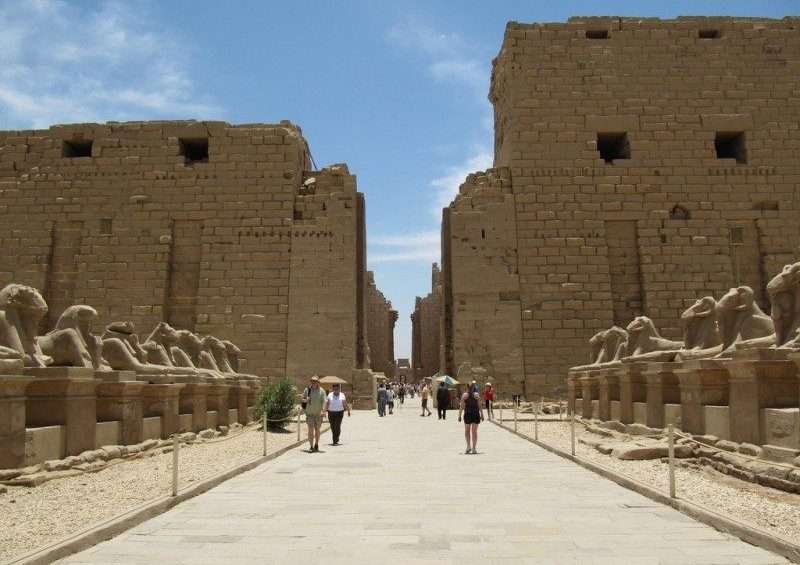
The grand entrance to Karnak is connected to Luxor Temple by a 3-kilometer La avenida de las Esfinges. These guardian statues, with lion bodies and ram heads, symbolized strength and protection. This ceremonial road was used during the Opet Festival and major processions.
2. The Great Hypostyle Hall
The most famous part of Karnak is the Gran Sala Hipóstila, a forest of 134 massive columns arranged in 16 rows. Some columns reach 21 meters in height and are decorated with hieroglyphs and scenes depicting pharaohs offering to the gods. This hall, built by Seti I and completed by Ramses II, is one of the most awe-inspiring achievements of Egyptian architecture.
3. The Sacred Lake
The temple features a large Lago Sagrado, symbolizing the primeval waters of creation. Priests used it for purification rituals, and it was also home to sacred geese and boats used in festivals.
4. Obelisks of Karnak
El El Templo De Karnak is famous for its towering obelisks. Queen Hatshepsut erected one of the tallest surviving obelisks in Egypt, standing 29 meters high and weighing 300 tons. These obelisks were carved from a single piece of granite and represented rays of the sun god Ra.
5. The Sanctuary of Amun
At the heart of Karnak lies the Sanctuary of Amun-Ra, where the sacred statue of the god was kept. Only priests and the pharaoh were allowed to enter this holy chamber, which was the spiritual center of the temple.
The Religious Role of Karnak Temple
El El Templo De Karnak was the main place of worship for the Theban Triad:
-
Amón-Ra – King of the Gods, symbolizing creation and power.
-
Mut – His consort, the mother goddess.
-
Khonsu – The moon god, associated with time and healing.
The temple was also dedicated to other deities such as Ptah, Osiris, Montu, and Sekhmet, making it a universal center of religion.
Priests performed daily rituals to “awaken” the statue of Amun, cleanse it, and present offerings of food, drink, and incense. Festivals celebrated at Karnak reinforced the connection between the gods and the people, ensuring harmony in both nature and society.
Karnak Temple in the Afterlife Beliefs
In Egyptian cosmology, temples like Karnak were not only earthly houses of the gods but also reflections of the cosmos itself. The architecture symbolized the creation of the universe: the sanctuary represented the primeval mound, while the ceiling depicted the sky and the floor represented the Nile’s fertile soil.
Thus, the El Templo De Karnak was a place where heaven and earth met, ensuring the eternal balance of life and death.
Decline and Rediscovery of Karnak Temple
With the fall of the pharaonic era, the El Templo De Karnak gradually lost its importance. During the Greco-Roman period, some parts were still used, but after Christianity spread in Egypt, the temple complex was abandoned and partly destroyed. Some sections were even converted into churches.
In later centuries, desert sand and the Nile’s flooding buried much of the site. It was not until the 19th century, with the rise of Egyptology, that archaeologists began serious excavations. Since then, Karnak has been carefully restored and studied, revealing its immense historical value.
Karnak Temple Today: A UNESCO World Heritage Site
Hoy en día, la El Templo De Karnak is one of the most visited attractions in Egypt, drawing millions of tourists each year. It is part of the UNESCO World Heritage Site of Ancient Thebes with its Necropolis, which also includes Luxor Temple, the Valley of the Kings, and the Valley of the Queens.
Visitors can explore its massive halls, carved walls, and sacred spaces, gaining insight into the grandeur of ancient Egyptian civilization. The Karnak Sound and Light Show, held in the evenings, brings the temple to life with a dramatic narration of its history.
The Legacy of Karnak Temple
El El Templo De Karnak remains not only a monument of stone but a symbol of the enduring power of faith, art, and human ambition. Its vast columns, sacred sanctuaries, and monumental obelisks tell the story of Egypt’s greatest pharaohs and their devotion to the gods.
Studying Karnak helps us understand how religion and politics were intertwined in ancient Egypt and how architecture was used to express cosmic order and divine power.
Conclusión
El El Templo De Karnak is far more than an archaeological site—it is a living testament to the brilliance of ancient Egyptian civilization. Built and expanded by generations of pharaohs, it reflects over two millennia of religious devotion, political ambition, and artistic achievement.
Whether you stand in awe beneath the towering columns of the Great Hypostyle Hall or walk along the Avenue of Sphinxes, visiting Karnak is like traveling back in time to the golden age of Egypt.
As one of the greatest wonders of the ancient world, the El Templo De Karnak continues to inspire scholars, travelers, and dreamers alike, keeping alive the legacy of the pharaohs and their gods.
book with us now Cruceros Por El Río Nilo